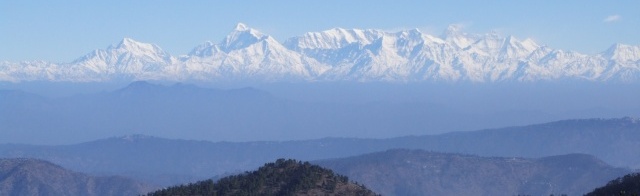
Highlands (Himalayan foothills) 13
- 24 Jan.: Kosi river, Corbett NP, Nainital area (Pangot, Sat Tal).
Lowlands 25 Jan - 1 Feb.: Ranthambore NP, Bharatpur (+ Bund Baretha),
Chambal river. Plus roadside areas in between.
On 12 Jan. Okhla (riverine reserve near Delhi).
A winter trip to North India is a
rather cold business but very rewarding. Many birds of the higher
parts of the Himalayas, Tibet and northern Asia have come down to join
the many resident birds in the foothills and the lowlands. This winter
had been very dry even in the highlands (no precipitation since
September 2007 at many places), and January 2008 appeared to be colder
than in 'normal' years. Despite these drawbacks we (my wife Nollie, a
birder too, and me) had a great time, with 398 species of which 178
were lifers. This was for a large part due to the excellent private
guiding by Asian Adventures, the company that is used by many birders
these days.
Guiding
For us it was the first time (after many worldbirding trips) that we
used guides and drivers for a whole trip. We did this because, despite
my travel experience in India long ago, we were a bit frightened by
the idea to have it all sorted out ourselves in this country. Also, we
wanted to know, for future trips to comparable countries, if a fully
organised trip would please us or not. We are used to have complete
freedom on most trips (not even making reservations) so this would be
completely different. Well, we must say that we were pleased indeed
and this was certainly due to the good company and good quality of our
guides and drivers, and to the good organisation by Asian Adventures.
Maybe we have been lucky with the guides and drivers we got, this
could be different I think. We had Hari Lama for the highlands and
Ratan Singh for the lowlands. Hari is from Nepal and knows his birds
and the spots where to look well, has a very sharp eye and is very
persistent in finding you the birds you want. Ratan is the famous
guide since long and we used his great experience with much pleasure.
Both are pleasant company, as were their drivers (Hariz in the
highlands, Cibi in the lowlands). Driving in India is a profession apart and both drivers were
careful and skillful. Guides and drivers also took care of our
communication with the owners of the lodges and hotels we stayed in,
where we also had nearly all of our meals.
Field guide
We checked every new bird species in the field guide, at the spot. We
always wanted to be sure that we had seen the critical field marks, so
we could add these species with confidence to our trip and life lists.
The guides did not object at all to these checks, and this is another
sign of their good professionalism. We used the Grimmett & Inskipp
field guide for Northern India, which I had studied well, and I also
had made a quick index for it (you can download it here).
I had also brought about 50 sounds of difficult and/or wanted species.
We only sparsely used them for taping out birds, and this seems to
work less than in e.g. South America, except the Collared Owlet sound
for attracting mobbing song birds but this sound can also be easily
whistled. We had brought our lightweight telescope (Nikon Fieldscope)
and used it often, even in wooded areas.
Duration
We had arranged everything directly with Asian Adventures (based in
Delhi), like our British friends had done a year earlier. They had two
weeks for this trip, like most birders do. Many birders have said that
they would have liked a longer stay at several of the sites, so we
chose to do this trip in three weeks in stead of two. And although we
did get a few extra trip ticks on the last day of every site indeed, I
think that c. 16 birding days is sufficient for this trip. We had
specific wishes, e.g. regarding the sequence within the trip. For
example, we don't like to be the last night far from the airport where
you have to return back home, in order not to miss the plane because
of being snowed in (possible at Pangot), or being dependent of a
single daily internal flight (from e.g. Jodhpur). This resulted in
quite some emails with AA. Afterwards it appeared that I could have
left all this to a local birding travel agent in Holland
(birdingbreaks.nl).
Tipping
One of the very few things we really had to arrange ourselves was the
tipping. This may seem trivial, but in India this is not trivial at
all. Many wages are so low that a reasonable tip can make the difference
for e.g. the staff of a lodge or a hotel/restaurant. Also, the guides
and the drivers deserve a good tip after having done so much for you
all these long days. Just formulate for yourself a reasonable
percentage of the total trip cost (excluding the flight). This may
lead to a rather large absolute amount of tip money, but for you it is
just this percentage, whereas for them it really helps.
Health
As it was mid winter, we saw no mosquitos at all (except one near
Ranthambore), and hence did not take malaria pills. In mild winters
this can be different, esp. in the lowlands (like Ranthambore).
Officially all of India has a malaria risk year-round below 2000 m.
To minimise the risk of 'Delhi belly' we ate no salads at all (as you
cannot be sure if it has been washed with bottled water). Bottled
water is for sale everywhere.
Always ask for a separate heater in your room if it's too cold. Really
expect low temperatures, so bring fleece and down clothing, with
gloves and warm cap. Even when it's a mild winter, the temperature in
the highlands (over 2000 m) can be very low, esp. in the morning.
Tigers
Birding in North India will always be combined with some tiger
watching. We had tigers both in Corbett and Ranthambore, but you may
not be that lucky, so don't count on it (as many general tourists
still seem to do). In Corbett you drive around on your own (a local
guide is added to your car) so that means that the birding can go on,
except that you are not allowed to leave the car. In Ranthambore it's
different. Here, only special vehicles (open jeeps and open trucks)
are allowed, so you have to join other tourists. This means that you
cannot stop at every small bird you see. Moreover, Ranthambore is
divided in five sections, of which section 3 and 4 are the best for
tigers (and possibly also for birds). This is well known so most
people want a ride in 3 or 4. Hence, a lottery now decides in which
section you will be. We had three rides (and saw many birds, thanks to
the patience and even interest of the other guests in our jeep) but
neither was in 3 or 4. Yet we saw a tiger and even a leopard, both in
section 2. For the rest, much of the birding in both Corbett and
Ranthambore is done in the border areas where you can leave your car.
Birds
As you can see at the top of the species
list, all sites had a reasonable number of species species that we did not see at other
sites too. Low numbers appear for esp. the world-famous
Bharatpur NP, which is very dry the last years. The World Heritage
organisation has even threatened to withdraw the heritage status of
this wetland reserve. Even the birds of the drier parts of Bharatpur
seem to suffer of the drought, possibly because of the lack of
insects. However, the nearby Bund Baretha site compensates some of the
loss in Bharatpur, as you can see in the species list.
The best bird of the trip did we get on the second day already:
Ibisbill! This enigmatic bird species was for many birders and for
many years one of the main reasons to visit N India, but the last
years it was absent from its stake-out near Ramnagar. The birds winter
in the gravel plains of the Kosi river, but alwas in very low numbers.
Our guide Hari had found them back lately, and we were very glad that
we saw them.
Good or reasonable numbers of species did we get of the following bird
groups: vultures (7), raptors (27), partridges etc. (10), lapwings
(4), Tringa sandpipers (6), sandgrouse (2), parakeets (5), owls (8),
barbets (5), woodpeckers (16), larks (8), wagtails & pipits (10),
bulbuls (8), accentors (3), thrushes (10), prinias (6), Phylloscopus
warblers (10), chats of all sorts (33), laughingthrushes (7), babblers
(9), tits (6), nuthatches (3), shrikes (5), drongos (6), Passer
sparrows (5), rosefinches (3), Mycerobas grosbeaks (2), buntings (4).
Our British friends who did the same trip a year earlier (although in
2 weeks) had 383 bird species, of which 52 that we did not see. So the
combined list of both trips has 450 species, a total that may be
possible on a long trip and under good conditions (not so cold, and
not so dry in the foregoing months).
Itinerary
(see
also species list for birds for each
locality; species mentioned below are only some of the highlights)
11 Jan. 2008 midnight arrival in Delhi, straight to hotel (for 2
nights).
12 Jan. birding at Okhla reserve along the Yamuna E of Delhi (gulls,
White-tailed Stonechat, Sind Sparrow, Red Avadavat); late afternoon
lost in heavy traffic of Delhi.
13 Jan. drive to Tiger Camp at Kosi river, where we met Hari Lama, our
guide for the next 11 days; afternoon first to Kosi river for
Ibisbill!, then on to Dikhala in Corbett NP for 2 nights stay (Kalij
Phaesant, 2 fish-eagles, Long-billed Thrush, Tiger)
14 Jan. all day Corbett NP around Dikhala, both in forest (morning)
and in grassland (afternoon); 3 lifer woodpeckers; Pied Harrier and
Hodgson's Bushchat in wet grassland area W of Dikhala.
15 Jan. morning around Dikhala, afternoon slowly back to Tiger Camp
(for 3 nights stay); Brown and Tawny Fish-Owls, Mountain Hawk-Eagle,
Otter.
16 Jan. morning Kosi river (up to Kumeria), afternoon slow drive along
very quiet tarmac road to isolated village in S part of Corbett NP at
c. 17 km WNW of Ramnagar; Brown Dipper, Little Forktail and
Rufous-bellied Niltava at Kumeria; Chestnut-headed Tesia a bit inland;
Spangled Drongo, Long-billed Pipit on afternoon drive.
17 Jan. remaining sites around Tiger Camp (also opposite side of
river); Great Slaty Woodpecker (a long-standing wish-list species),
White-tailed Rubythroat, Emerald Dove.
18 Jan. morning slow drive to Pangot (2200 m altitude, in Nainital
area; for 4 nights), afternoon birding below Pangot (mixed habitat);
Great Barbet, Black Eagle, Indian Spotted Eagle and many new
songbirds; very good view of the endangered Grey-crowned Prinia (2
specimens) in bushes below Pangot.
19 Jan. morning to areas above Pangot, afternoon walk below Pangot;
Himalayan and Rufous-bellied Woodpecker, Upland Buzzard, Yellow-browed
Tit, Black-throated Accentor, Spectacled Finch, Dark-breasted
Rosefinch, Brown Bullfinch.
20 Jan. cold wind during another whole day around Pangot, few but good
birds; morning below Pangot, afternoon above Pangot; Hill Partridge,
Koklass Phaesant, Scaly-bellied Woodpecker, Long-tailed Thrush,
Spot-winged Grosbeak.
21 Jan. last full day at Pangot, no wind but very cold; morning to
areas very high above Pangot, afternoon walk below Pangot again;
groups of c. 15 Spectacled Finch and c. 8 Collared Grosbeak, and
better views of Koklass Phaesant; splendid views of Himalayan
snowcapped mountain range.
22 Jan. early drive to Sat Tal (for 2 nights stay); birding in dry
gully c. 3 km before dam and area below dam; Dark-throated Thrush,
Golden Bush-Robin, Scaly Wren-Babbler, Red-billed Leiothrix,
Fire-tailed Sunbird (male), White-capped Bunting.
23 Jan. morning to areas above Sat Tal, afternoon walk from lodge to
Sat Tal dam area; Tickell's Thrush (thanks to tip of two Swedes),
Snowy-browed Flycatcher (male), White-browed Shrike-Babbler,
Fire-fronted Serin.
24 Jan. morning last try for Bush-Warblers (too cold probably), late
afternoon left for night train from Lal Kuan to Mathura, with our new
guide Ratan Singh.
25 Jan. early arrival at Mathura junction, where picked up by our new
driver Cibi for long drive to Ranthambore NP (for 3 nights stay); many
dry area species along the road; Painted Sandgrouse in afternoon W of
NP.
26 Jan. Independence Day (Saturday) so very crowded at Ranthambore NP
but still saw Painted Spurfowl and Sirkeer Malkoha there, plus Leopard
(afternoon jeep safari in section 2);
morning
jeep safari in section 1 very quiet, but got White-naped Woodpecker.
27 Jan. morning section 2 again and now with Tiger; afternoon to
fields W of NP: Indian Courser, Blackbuck, Singing Bushlark.
28 jan. John bit ill but managed to go on, during slow drive to
Bharatpur (for 3 nights stay); Barred Buttonquail, Black-bellied Tern,
Chestnut-bellied Sandgrouse.
29 Jan. all day visit to Bund Baretha (varied lowlands area);
Brown-headed Barbet, Indian Skimmer, Blyths Reed-, Plain Leaf and
Paddyfield Warbler, Rufous-tailed Lark, Orange-headed Thrush.
30 Jan. Bharatpur NP; Black-necked Stork, Dusky Eagle-Owl; Sarus Crane
(latter just outside NP).
31 Jan. morning quick visit to tree nursery (Brown Hawk-Owl), then on
to Fatehpur Sikri and Taj Mahal monuments (short visits), and to
Chambal river lodge (for 1 night stay); Black (Red-naped) Ibis along
the road.
1 Feb. early morning around lodge (Brown Hawk-Owl), then river cruise
at Chambal river: Pallas'Gull, Lesser Whistling-Duck, Sand Lark (and
great views of Indian Skimmer); afternoon drive to Delhi for night
flight back to Holland. |