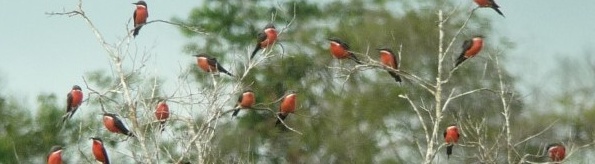
Birding trip report Gabon (Gamba area) 14-29 Sep. 2009
See also Species list and GPS waypoints/maps
For photos of the birding sites etc., see the larger version (many MB's)
The most abundant bird families were: hornbills (I think we saw them at least every half hour or so), cuckoos (more heard than seen), bee-eaters, greenbuls and sunbirds.
We owe a lot to Dave Sargeant's extensive report of the birds of the area in the early nineties (D.E. Sargeant 1993 - Gabon, a birder's guide; with emphasis on the Gamba area). There is also a local Smithsonian institute, and around 2005 a few articles appeared about the broader area. Nevertheless, we had to sort out many things locally ourselves, partly also because two birding contacts we had hoped to meet happened to be out. However, we really liked to explore the area, and this was hugely facilitated by the permanent use of the Toyota Landcruiser of our hosts Nolda and Jonathan. As a matter of fact, their very employment at Shell Gabon (Gamba) gave us the opportunity for coming to this remote destination. Actually, visiting the Gamba area without such contacts will not be easy. That said, it was a pleasant experience to be part of the Shell community in this isolated location.
We booked our Air France flight to Libreville from Paris instead of from Amsterdam, as the fare was over 400 euro per person cheaper this way.
Forest Elephants roam the Gamba area at night, and they are especially fond of the mango trees in the gardens of Yenzi, the Shell village. As these animals can be grumpy, one has to be very careful. For example, walking at night in Yenzi was not allowed. Of course, while walking forest tracks during the day we were always on our guard and hoping not to meet an elephant. After the tragic loss in April 2009 of a Dutch worldbirder due to a forest elephant in India, we were always very keen on hearing any branches breaking. This also meant that we only rarely left the forest tracks for finding skulking birds along the often indistinct elephant/buffalo trails. Snakes can be more difficult to see on those trails as well (we saw two big ones, although both from the car). We never encountered an elephant in the forests, but on the last night we saw a few closeby in Yenzi, from our (screened) veranda.
We took anti-malaria pills for the whole period, as there have been casualties in the area.
Although we hardly met anyone on our day trips, speaking French in this former French colony made things easier when we asked local people near plantations about the roads etc. Or, for learning from a local driver one morning in the middle of nowhere, that we had just 'missed' a silverback gorilla with two young...
Yenzi - the compound of the Shell employees; see first photo below; lush green open woodland and lawns.
Golf course - between Yenzi, lake Yenzi and woodland.
Open woodland W of Yenzi.
Degraded woodland/forest E of Yenzi lake.
'Mangrove road' opposite airport, leading to the sea; coastal scrub, mangrove, woodland.
'Vera plains' generic term for the rolling grassland hills E of airport area; mainly the forest blocks between them, like Bibonga, Tondou and 'Mark's forest'.
Bibonga forest - primary forest, hardly affected.
'Tondou forest' - Dave Sargeant's favorite and indeed very good although being affected bit by bit now; the forest is hard to find these days (but see GPS section), and the locals we met don't use the name Tondou.
'Mark's forest' - hard to find lush forest track pointed out to us by Mark (see GPS section), good for mixed species flocks.
Colas - coastal scrub and beach.
Nyanga - coastal scrub, small lagoons, estuary, beach.
Matsiegui lagoon - lake and a tidal mudflat/lagoon.
Totou road - tall forest.
Plus several minor sites.
All in all, we had a lovely time on a single and comfortable location in a remote near-wilderness, where we had a good introduction to the birds of tropical west-central Africa, plus several restricted-range specialties like African River-Martin and Rosy Bee-eater.